Comparison of Tidal Modes
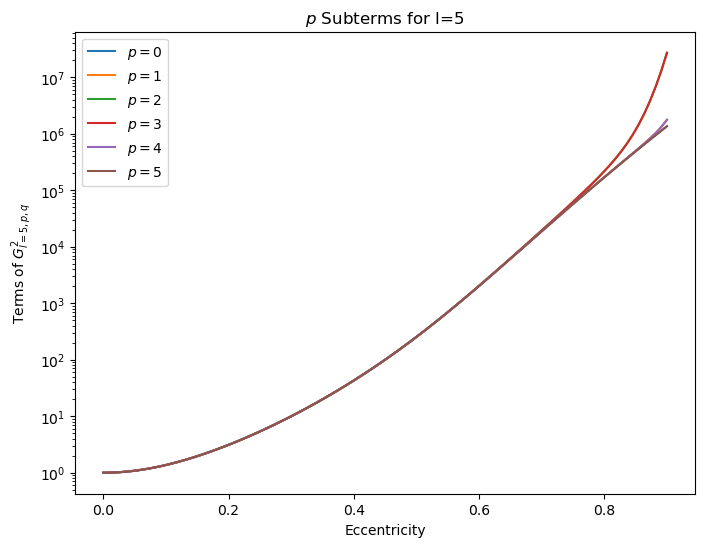
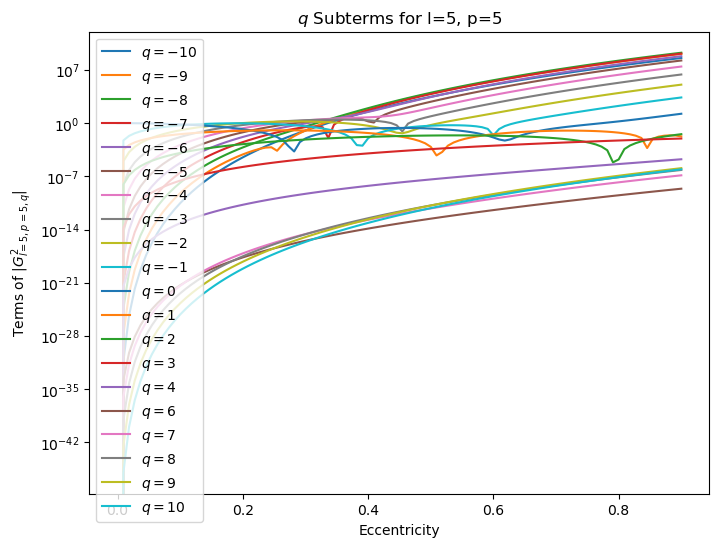
In this demo we will show the relative strength of various tidal modes by looking at the eccentricity functions.
[1]:
import numpy as np
import matplotlib.pyplot as plt

# Choose which l you want to look at. Here we will look at l=2
max_l = 5
from TidalPy.tides.eccentricity_funcs import orderl5 as eccen_funcs

eccentricity_domain = np.linspace(0., 0.9, 100)

# Choose which truncation level to use. Here we will look at truncation level 6
eccentricity_results = eccen_funcs.eccentricity_funcs_trunc20(eccentricity_domain)
[2]:
# Plot the results by collapsing all "q" results into a single value.
fig_p_compare, ax_p = plt.subplots(figsize=(8,6))
fig_q_compare, ax_q = plt.subplots(figsize=(8,6))
ax_p.set(xlabel='Eccentricity', xscale='linear', ylabel='Terms of $G^{2}_{l=' + f'{max_l}' + ',p,q}$', yscale='log')
ax_q.set(xlabel='Eccentricity', xscale='linear', ylabel='Terms of $|G^{2}_{l=' + f'{max_l}' + ',p=' + f'{max_l}' + ',q}|$', yscale='log')
ax_p.set(title=f'$p$ Subterms for l={max_l}')
ax_q.set(title=f'$q$ Subterms for l={max_l}, p={max_l}')
for p in range(max_l+1):
    q_collapsed = 0.
    for q, q_res in eccentricity_results[p].items():
        if p == max_l:
            ax_q.plot(eccentricity_domain, np.abs(q_res), label='$q=' + f'{q}' + '$')
        q_collapsed += q_res
    ax_p.plot(eccentricity_domain, q_collapsed, label='$p=' + f'{p}' + '$')

ax_p.legend(loc='best')
ax_q.legend(loc='best')
plt.show()